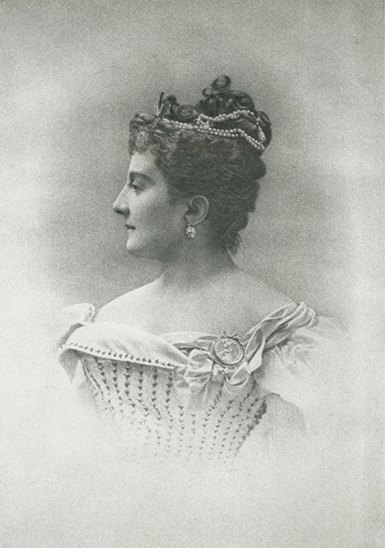
 Princess Ralouka "Rachel" Musurus de Brancovan (c. 1847/1848 – September 26, 1923) was a Greek-Ottoman aristocrat, talented pianist, and prominent Parisian salonnière.
Queer Places:
Villa Bassaraba, Route D1005 (Route de Genève), 74500 Publier (Amphion-les-Bains), France
Cimetière du Père-Lachaise, 6, rue du Repos, Paris 20e, Paris, Île-de-France, France
Princess Ralouka "Rachel" Musurus de Brancovan (c. 1847/1848 – September 26, 1923) was a Greek-Ottoman aristocrat, talented pianist, and prominent Parisian salonnière.
Born in Constantinople around 1847 or 1848, Rachel was the daughter of Constantine "Costaki" Musurus Pasha (1807–1891), a Greek Phanariote diplomat who served as the Ottoman Empire's ambassador to the United Kingdom, and Anne Vogorides.
Raised in an cosmopolitan and diplomatic environment—including years spent at the Turkish Embassy in London—she studied piano under Camille Dubois, one of Frédéric Chopin's notable pupils. Musurus developed into an accomplished pianist, later becoming a key patron and muse to the Polish composer Ignacy Jan Paderewski, who dedicated several works to her (including his Nocturne, Op. 16 No. 4 and Fantaisie polonaise, Op. 19).
On May 28, 1874, in London, she married Prince Grégoire Bibesco-Bassaraba de Brancovan (1827–1886), a Romanian-French prince and son of Wallachian Prince Gheorghe Bibescu. Following their marriage, the couple settled in France, spending time between Paris and their estate Villa Bassaraba in Amphion, near Évian.
The couple had three children: Prince Constantin Michel Bibesco-Bassaraba de Brancovan (1875–1967), Anna, Comtesse Mathieu de Noailles (1876–1933) and Princess Hélène Bibesco-Bassaraba de Brancovan (later Princess de Chimay; 1878–1929)
Following her husband's death in 1886, Princess Rachel maintained a vivid cultural and artistic circle in Paris and at Villa Bassaraba. Her musical and literary gatherings brought together key figures of the Belle Époque, including Marcel Proust, Prince Edmond de Polignac, Winnaretta Singer (Princesse de Polignac), Abel Hermant, and Léon Delafosse.
While Rachel de Brancovan lived within conventional aristocratic norms, her life and family circle intersected significantly with prominent figures of late 19th- and early 20th-century LGBTQ+ cultural history:
Rachel was the mother of celebrated poet and novelist Anna de Noailles. Anna was a central figure in Parisian literary circles and engaged in intense, emotionally complex, and romantic relationships with both men and women—most notably maintaining intimate artistic and personal bonds with fellow female writers and salon figures of the Belle Époque.
Rachel’s salon hostings brought together many figures of the queer Parisian avant-garde. Notably, she was close to Princesse Edmond de Polignac (Winnaretta Singer)— one of the grandest patrons of music in Paris, who lived in a famed mariage de convenance with Prince Edmond de Polignac while maintaining open lesbian relationships—and Marcel Proust, a frequent guest of both Rachel and her daughter Anna.
Princess Rachel de Brancovan passed away in Paris on September 26, 1923 at the age of 75, and is buried in the Père Lachaise Cemetery in Paris, France. She rests within the Bibesco-Brancovan family chapel located in Division 28 (along the chemin du Dragon), alongside her husband, Prince Grégoire Bibesco-Bassaraba de Brancovan, and their daughter, the poet Anna de Noailles.
References:
Support this project
This website is a passion project researched, developed, and funded entirely by me. If you find the content valuable and would like to help support the ongoing research and hosting costs, any contribution is deeply appreciated.
Thank you for keeping this independent resource alive!
My books on Amazon: Elisa Rolle's books